
Serious accidents often happen during normal maintenance activities
In many industrial environments, machines and installations operate continuously for hours, days or even weeks without interruption. Employees become familiar with equipment, production processes and routine maintenance tasks. Because everything appears normal, many organizations underestimate one of the most dangerous moments inside industrial operations: maintenance, repair and servicing activities.
A machine that is running during production is often well protected with guards, emergency stops and safety systems. However, when maintenance starts, many of these protections are temporarily bypassed or removed. At that moment, employees may suddenly be exposed to hazardous energy sources that can cause severe injuries or fatalities within seconds. This is exactly why Lockout Tagout, usually referred to as LOTO, has become such an essential part of industrial safety worldwide.
 LOTO is a structured safety procedure designed to ensure that machinery, equipment and installations are completely isolated from hazardous energy sources before maintenance or servicing work begins. The purpose is simple but critically important: prevent machines from unexpectedly starting up or releasing stored energy while employees are working on them.
Many serious industrial accidents occur because equipment unexpectedly becomes energized while someone is still inside a dangerous area. A conveyor may suddenly restart. A valve may unexpectedly open. Hydraulic pressure may release without warning. Electrical systems may become live again. These situations can lead to crushing injuries, amputations, electrocution, burns or fatal accidents.
What makes these incidents particularly tragic is that many of them are entirely preventable. LOTO procedures were developed precisely because companies around the world realized that relying only on verbal communication or assumptions was not enough to protect workers. In many accident investigations, the root cause turns out to be surprisingly simple. One employee believed a machine had already been isolated. Another worker restarted equipment without realizing someone was still performing maintenance. Sometimes stored pressure, residual electrical energy or gravity-related movement was overlooked completely. This is why modern Lockout Tagout procedures focus on creating a physical barrier between hazardous energy and employees performing work.
The concept itself is straightforward. Before maintenance begins, all energy sources must be identified, isolated, locked and clearly tagged. The lock physically prevents reactivation, while the tag communicates that maintenance work is in progress and identifies who applied the lock. However, effective LOTO programs involve much more than simply placing locks on switches.
Modern industrial systems are increasingly complex. Equipment may contain multiple energy sources at the same time, including electrical energy, hydraulic pressure, pneumatic systems, steam, compressed gases, thermal energy, stored mechanical force or even gravity. Employees therefore need proper training to fully understand how hazardous energy behaves and how to safely isolate it. This is why LOTO awareness and training programs have become mandatory or strongly recommended in many industries worldwide.
Looking for an LOTO Awareness training ?
Hazardous energy exists in far more forms than many workers realize
One of the biggest misconceptions about Lockout Tagout is that many people associate it only with electricity. In reality, hazardous energy can exist in many different forms, and all of them can create life-threatening situations if not properly controlled. Electrical energy is obviously one of the most visible hazards. Live electrical systems can cause severe burns, electrocution or arc flash incidents. But many industrial accidents occur because workers underestimate other forms of stored energy.
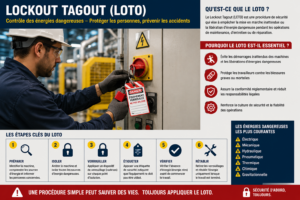 Hydraulic systems, for example, can remain pressurized even after equipment has been switched off. A sudden release of hydraulic pressure can move heavy machinery unexpectedly or eject components with tremendous force. Pneumatic systems using compressed air create similar dangers. Residual air pressure may remain trapped inside pipes or cylinders long after operations have stopped. Mechanical energy also creates significant risks. Springs under tension, rotating components, elevated loads or moving machine parts may suddenly shift if energy is not properly controlled. Thermal energy presents another challenge. Hot surfaces, steam systems or heated equipment can remain dangerous even after machinery has been powered down. Gravity itself can also become a hazardous energy source. Raised machine parts, suspended loads or elevated platforms may unexpectedly fall if not properly secured.
Many employees only begin to realize the complexity of hazardous energy once they receive proper LOTO training. This awareness is especially important because maintenance activities often take place during non-routine situations. Guards may be removed, normal procedures interrupted and multiple contractors or departments working simultaneously in the same area.
Communication failures become much more likely in these environments. That is why effective Lockout Tagout programs are built around standardized procedures rather than assumptions or verbal agreements. Employees need to understand exactly how to identify energy sources, isolate them safely, verify zero energy and communicate clearly with others involved in the work.
Another important aspect is that LOTO is not only relevant for maintenance technicians. Operators, supervisors, contractors, cleaners and production staff may all be exposed to hazardous energy risks depending on their activities. In many facilities, outside contractors perform maintenance work on complex machinery. Without proper coordination and standardized LOTO procedures, misunderstandings can quickly lead to dangerous situations.
Modern safety regulations increasingly emphasize the importance of documented energy control procedures, employee training and regular verification of LOTO practices. Authorities worldwide recognize that hazardous energy remains one of the leading causes of severe industrial injuries. This is why companies that take Lockout Tagout seriously are often significantly safer than organizations relying only on informal safety practices.
Human behavior remains one of the biggest challenges in LOTO safety
Technology and engineering controls have improved industrial safety enormously over recent decades. Modern machines often contain advanced sensors, emergency systems and automated safeguards. Despite this progress, serious accidents involving hazardous energy still continue to occur. In many cases, investigations reveal that human behavior played a major role. Someone bypassed a procedure because the task “would only take a minute.” An employee assumed another person had already isolated the equipment. Communication between departments failed. A worker removed someone else’s lock. A stored energy source was simply overlooked. These situations show why Lockout Tagout is not only a technical procedure, but also a behavioral safety issue.
One of the greatest dangers in industrial environments is routine. Employees performing the same tasks every day may gradually become less aware of the risks around them. Production pressure can also create unsafe shortcuts. When downtime is expensive, workers may feel tempted to skip certain safety steps to save time. This is exactly why LOTO awareness training is so important. Training helps employees understand not only how procedures work, but also why every step matters. Workers begin to recognize how quickly hazardous energy can turn a normal maintenance activity into a life-changing accident. Modern LOTO training programs often include practical examples, real accident case studies and hazard recognition exercises. These approaches help employees better understand the real-world consequences of unsafe behavior.
Another important aspect is personal responsibility. Lockout Tagout systems are designed so that each individual maintains direct control over their own safety. When an employee applies a personal lock, that person controls when the equipment may safely return to operation. This creates accountability and reduces the risk of miscommunication.
LOTO also plays an important role in broader safety culture development. Companies with strong energy isolation procedures often demonstrate higher levels of operational discipline overall. Employees working in organizations with mature LOTO systems usually develop stronger hazard awareness, better communication habits and greater respect for safety procedures. Many companies now use digital tools and e-learning platforms for LOTO awareness training. These systems allow employees to learn at their own pace and make it easier to keep training updated as procedures or equipment change. However, the effectiveness of any LOTO system still depends heavily on workplace culture. Procedures alone are not enough if employees do not truly believe in their importance. The most successful organizations create environments where safety is consistently prioritized over speed or production pressure.
The future of Lockout Tagout in an increasingly automated world
Industrial environments are changing rapidly. Automation, robotics, digital systems and smart manufacturing technologies are transforming factories, warehouses and production facilities worldwide.These developments create both new opportunities and new challenges for Lockout Tagout safety. Modern machines are becoming more interconnected and technologically advanced. Equipment may now contain automated restart systems, remote activation capabilities or software-controlled energy systems that create entirely new risks. At the same time, the growth of renewable energy systems, battery storage technology and advanced electrical infrastructure introduces additional forms of hazardous energy into industrial environments. Employees therefore require increasingly sophisticated understanding of energy control procedures.
Robotics presents another important challenge. Automated systems may suddenly move based on programmed sequences, sensor inputs or remote commands. Workers performing maintenance on robotic systems need specialized awareness of these risks. Cybersecurity is also becoming more closely connected to operational safety. In highly automated facilities, digital system failures or cyberattacks could potentially interfere with machine controls or energy isolation systems. This means that future LOTO programs may become more integrated with broader industrial safety and cybersecurity strategies.
Despite all technological progress, one reality remains unchanged: people continue to play the most important role in workplace safety. Technology can support safe operations, but it cannot replace human awareness, communication and responsibility. This is why Lockout Tagout awareness training will remain critically important for years to come. Companies that invest in proper hazardous energy training are not only reducing accident risks. They are also strengthening operational reliability, employee confidence and long-term business continuity. A serious LOTO-related accident can have devastating consequences. Beyond injuries or fatalities, incidents often lead to investigations, operational shutdowns, legal claims, reputational damage and major financial losses.
Preventing these incidents is not only a legal obligation. It is also a fundamental part of responsible business leadership. As industries become more advanced and energy systems more complex, the importance of effective Lockout Tagout procedures will continue to grow. Organizations that develop strong LOTO cultures today will be far better prepared for the challenges of tomorrow’s industrial world. Companies looking to improve hazardous energy awareness and Lockout Tagout safety can access modern e-learning and training solutions through and , including multilingual LOTO awareness courses designed for industrial, logistics and maintenance environments.